Oolook vs Buffer

Do You Need a Social Scheduler, or a Brand-Aware Marketing Workspace?

Buffer makes social publishing simple with queues, text AI, analytics, Community, and strong integrations. Oolook connects structured brand context, native creative production, reusable media, controlled publishing, reporting, and SEO content.

Comparison researched and reviewed on October 1, 2026

The short answer

Choose Based on Whether Publishing Is the Job—or One Step in the Job

Buffer is purpose-built for accessible social publishing. Oolook covers more of the brand, creative, asset, execution, and search-content workflow around publishing.

Choose Oolook when content needs brand context and execution

Oolook is the stronger fit when you want a structured Brand Kit, separated brand workspaces, native visual generation, reusable asset processing, controlled Copilot actions, destination-specific publishing, and SEO content together.

Choose Buffer when simple scheduling is the priority

Buffer is the stronger fit when you primarily need a clean publishing queue, unlimited text AI, modern network support, comment management, a capable Free plan, or unlimited Team users under channel-based pricing.

Feature comparison

Oolook vs Buffer at a Glance

Compare what each product does before, during, and after a social post is scheduled.

Decision areaOolookBuffer
Best suited toTeams that want structured brand context, native creative production, reusable media, controlled publishing, reporting, and SEO article workflows in one workspace.Creators and teams that primarily want simple, reliable multi-channel scheduling, text assistance, comment management, analytics, and broad integrations.
Account organizationBrand-specific workspaces separate Brand Kit information, media, profiles, posts, reports, and search projects.Organizes individual social accounts as channels, with channel groups and access controls available on eligible paid plans.
Multi-brand managementEach brand can operate in a separate workspace with its own context, media, profiles, content, and reports.Multiple brands can be represented through channels and groups, but a structured native client-workspace system was not documented.
Reusable brand contextA structured Brand Kit can guide supported Copilot, social, visual, media, and SEO workflows.AI Assistant can follow instructions supplied in the current prompt, but a persistent structured Brand Kit was not documented.
AI assistantOolook Copilot can inspect available workspace information and prepare supported actions for confirmation.Buffer AI Assistant generates ideas and captions and can rewrite, shorten, expand, summarize, change tone, and adapt text by platform.
External AI agentsThis comparison does not position public MCP or API access as an Oolook advantage.Provides MCP and API access for supported external-agent and integrated publishing workflows.
Caption generationGenerates captions and variants with supported brand and destination context.Provides unlimited text use of AI Assistant on the reviewed plans for ideas, captions, rewrites, tones, and repurposing.
AI images and carouselsSupports native AI image generation with references and output controls, plus coordinated multi-card carousel generation.Supports uploading and publishing images and carousels, but native AI image and carousel generation was not documented. Canva is available through an integration.
MoodboardsCan produce a visual-direction moodboard from image references and optional brand context.A native moodboard-generation workflow was not documented.
Existing-media processingIncludes background removal, resizing, reframing, color grading, palette extraction, and image or video upscaling.Provides basic image editing, cropping, rotation, flipping, appearance controls, alt text, and a separate Magic Resizer tool.
Media organizationA brand-specific Media Library supports uploads, generated outputs, search, processing, organization, and reuse.Supports media uploads and asset integrations such as Canva, Dropbox, Google Drive, OneDrive, Google Photos, and Unsplash.
Ideas and planningSupports brand-connected content preparation, drafts, scheduling, campaigns, media, and Copilot-assisted planning.Provides an Ideas area, drafts, tags, notes on eligible plans, templates, a visual calendar, and publishing queues.
Social schedulingSupports drafts, immediate publishing, scheduling, queue states, retries, destination controls, and publication-status monitoring.Provides established queues, custom schedules, calendars, immediate publishing, bulk workflows, duplication, and per-channel customization.
Platform validationChecks supported destination requirements before publication and exposes relevant settings by platform.Applies network-driven format and character requirements and uses reminder publishing for formats that cannot be posted directly.
First comments and hashtagsSupports destination-specific publishing controls within its established social workflow.Provides first-comment scheduling and saved hashtag groups on eligible paid plans.
AnalyticsProvides available profile and post metrics from supported connected social networks.Provides channel and post analytics, audience growth, engagement, reach or impressions where available, best-time guidance, takeaways, and paid report exports.
EngagementA comprehensive unified inbox is not used as an Oolook advantage on this page.Buffer Community focuses on comments across supported networks, with replies, filters, saved replies, AI reply suggestions, and comment-to-post workflows.
Team collaborationSupports reviewable Copilot actions and shared-content feedback. Current seats and permissions depend on the selected plan.Team includes unlimited users, channel access controls, approvals, collaboration workflows, and branded reports.
Publishing destinationsSupports established workflows for Facebook, Instagram, Pinterest, LinkedIn, YouTube, and TikTok, subject to platform APIs.Supports a broad modern list including Facebook, Instagram, LinkedIn, X, Threads, TikTok, Pinterest, YouTube Shorts, Google Business Profile, Mastodon, Bluesky, and Substack Notes.
Start PageA dedicated link-in-bio page builder is not positioned as an Oolook advantage here.Includes Start Page for link-in-bio publishing and analytics. A Start Page counts as a channel.
SEO content workflowSupports researched article workflows, generation, evaluation, editing, reevaluation, and optimization.A native keyword-research, article-scoring, page-audit, and SEO article workflow was not documented.
Free accessOffers an available Free plan, with current limits loaded from Oolook’s pricing API.Offers a permanent Free plan with up to three channels, ten scheduled posts per channel, Ideas, text AI, Community, basic Insights, and API access.
Pricing basisStandard plans scale through brand workspaces, profiles per brand, posts, storage, AI credits, reports, and support.Essentials and Team are priced primarily by connected channel, with volume discounts. Team includes unlimited users.
AI usage modelAI-powered work consumes plan credits. Standard scheduling, publishing, reporting, brand management, and Media Library storage do not consume AI credits.Reviewed plans include unlimited AI Assistant text use. Community AI replies have separate Free-plan limits.

Social-network APIs, supported formats, product features, and plan limits can change. Confirm purchase-critical requirements on each vendor's current official product, support, and pricing pages.

Oolook Copilot in action

Turn a Content Objective Into Scheduled Posts

Plan, prepare, review, and schedule destination-specific social content from the selected brand workspace. See how this connected Oolook workflow relates to teams evaluating Buffer.

Oolook Copilot

Brand-aware content preparation

Working in: Alder & Form
Ask anything
Brand details shown here are fictional. Actual output uses available information from the selected Brand Kit.
Prepare captions and creativeReview the publishing detailsConfirm and monitor publication
  1. 1

    Step 1

    Give Copilot the content objective

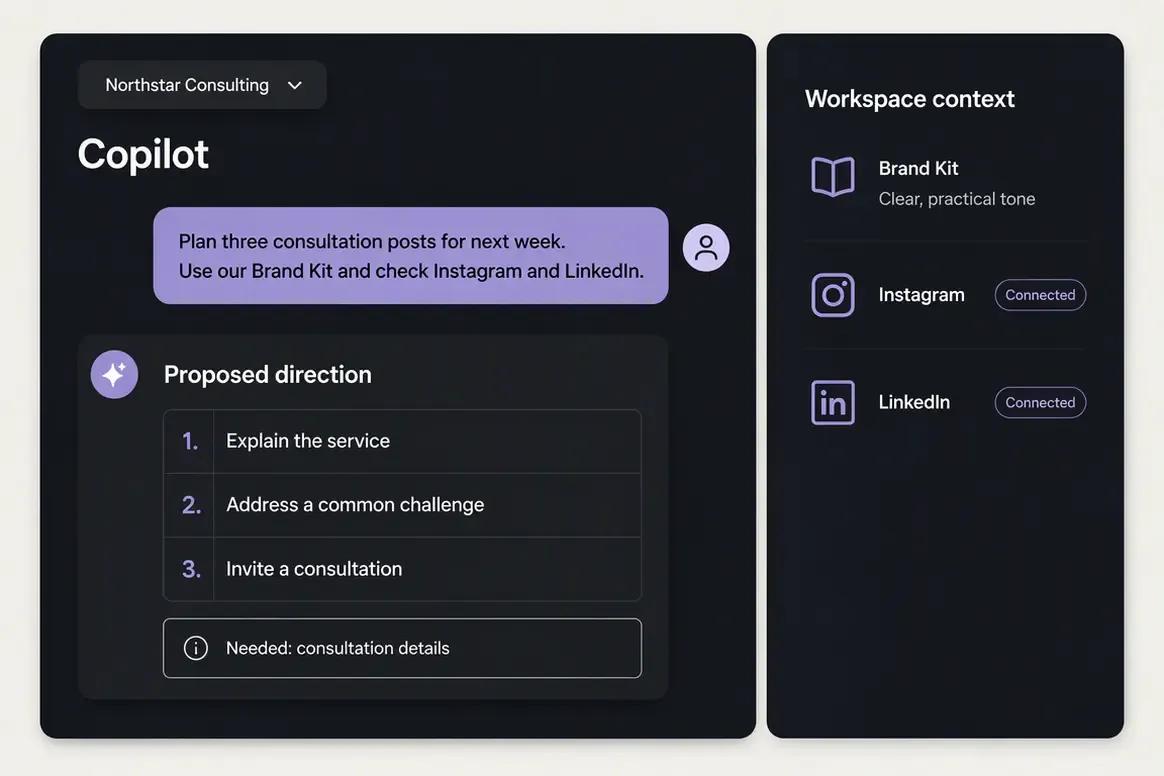
    Select the brand workspace and tell Copilot what you want to promote, who the content should reach, which social profiles should be used, and when the campaign should run. Copilot can use available Brand Kit and workspace context while identifying information that still needs confirmation.

    Ask Oolook Copilot
    “Help me prepare three posts for next week promoting our consultation service. Use our Brand Kit and check our connected Instagram and LinkedIn profiles.”
    Oolook Copilot receiving a social content objective inside a brand workspace
  2. 2

    Step 2

    Prepare captions and creative

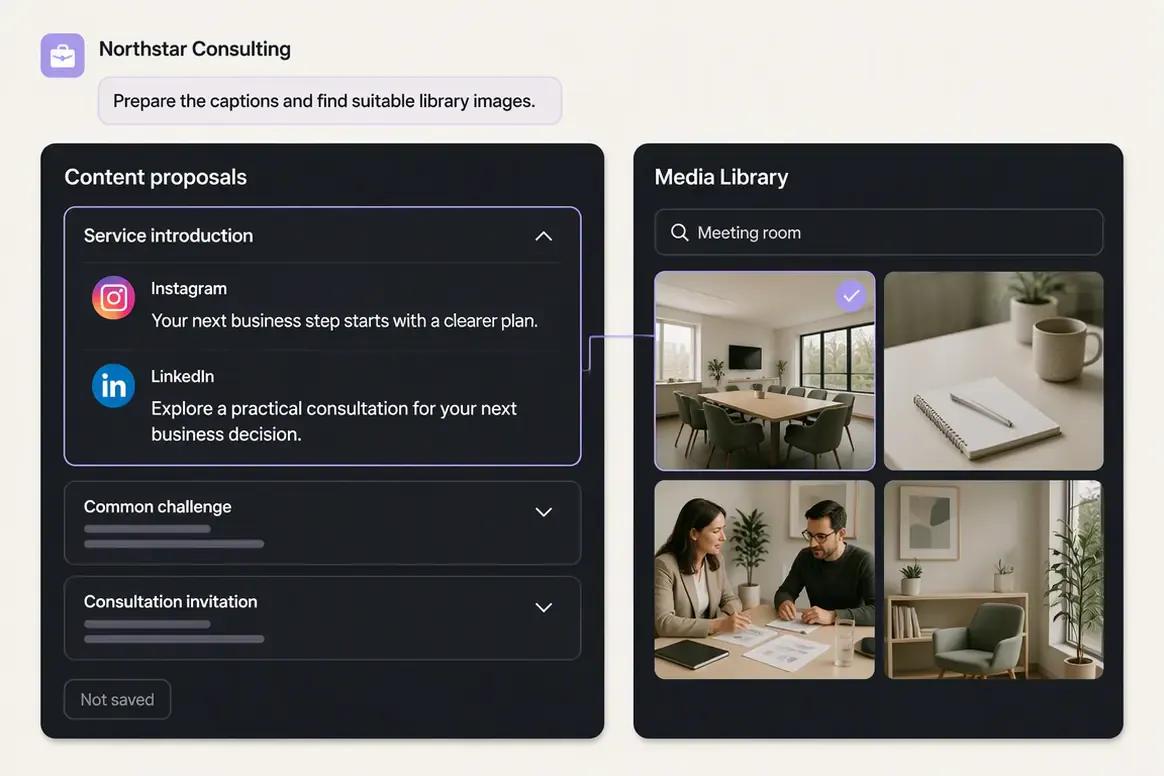
    Ask Copilot to prepare destination-specific captions and find relevant media from the brand's Media Library. If suitable media is unavailable, continue into an image or carousel generation workflow and review the generated output.

    Ask Oolook Copilot
    “Draft captions for these three posts and find suitable images in our Media Library.”
    Oolook Copilot preparing social captions and selecting brand media
  3. 3

    Step 3

    Review the publishing details

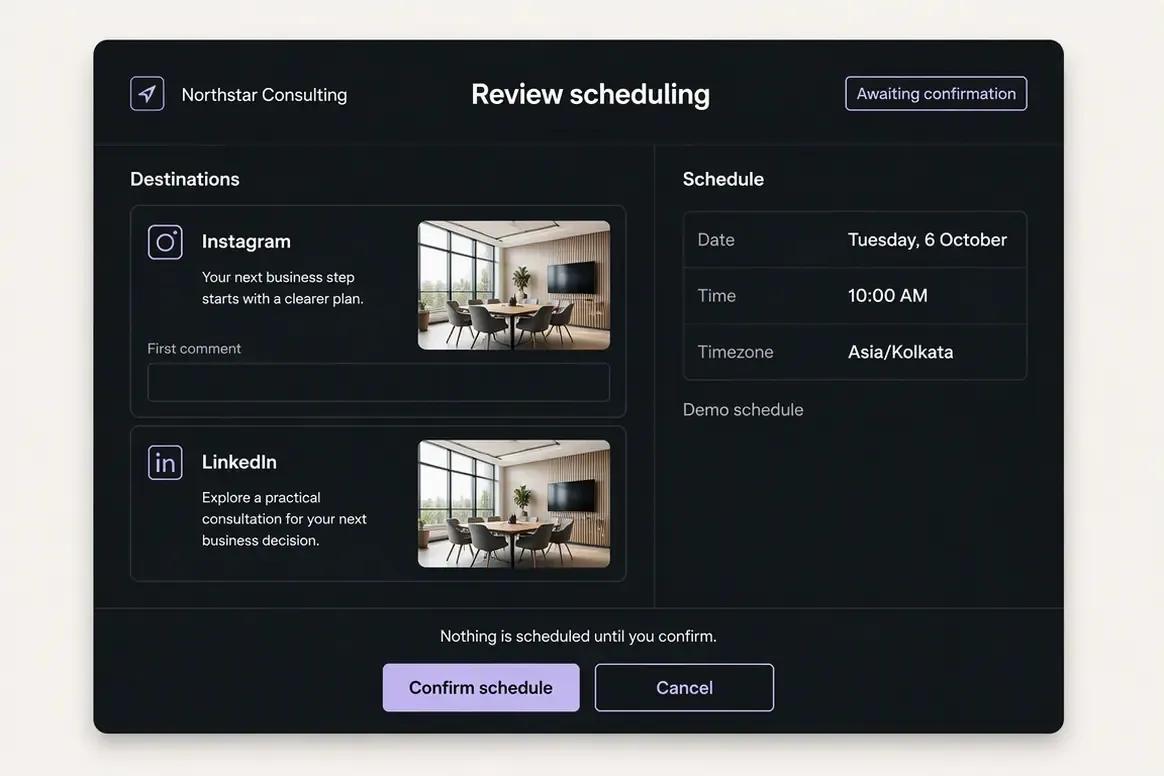
    Inspect the caption, selected media, destination, date, time, timezone, and supported platform settings. Copilot prepares the supported scheduling action so the complete change can be reviewed before confirmation.

    Ask Oolook Copilot
    “Prepare this post for Instagram and LinkedIn next Tuesday at 10 AM. Show me every publishing detail before scheduling.”
    Oolook social scheduling action ready for confirmation
  4. 4

    Step 4

    Confirm and monitor publication

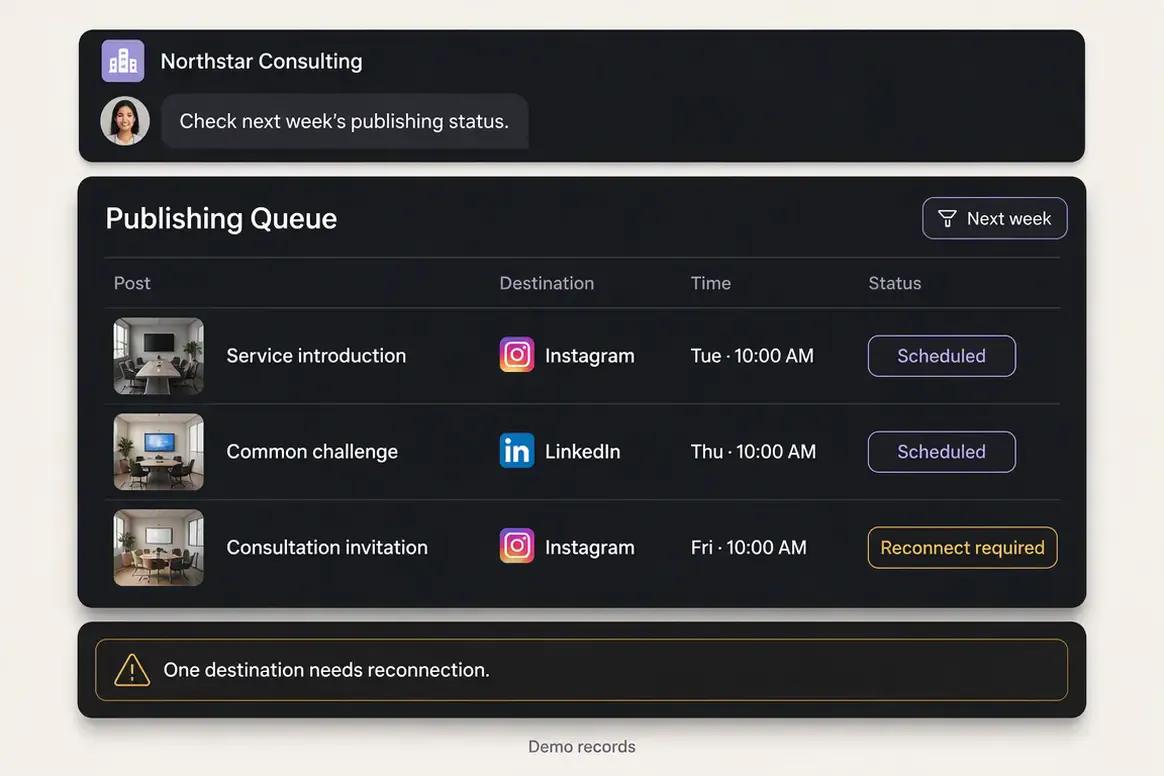
    Confirm the approved action and monitor the post through its scheduled, queued, publishing, completed, or attention-required state. Copilot can help inspect the available status information without hiding the underlying publishing state.

    Ask Oolook Copilot
    “Check the publishing status of the posts scheduled for next week and show me anything that needs attention.”
    Oolook publishing queue showing scheduled post statuses

Keep the Work Connected With Oolook Copilot

Move from brand context to reviewable content and supported actions without rebuilding the same marketing context across disconnected tools.

Start With Oolook

Why teams choose Oolook

Go Beyond Writing and Scheduling the Next Post

Oolook connects the brand, creative, media, publishing, reporting, and search-content work that a lightweight scheduler leaves to other tools.

Give Copilot the context Buffer asks you to provide manually

Oolook Copilot can work with available Brand Kit information, media, connected profiles, drafts, schedules, reports, search projects, and application history instead of relying only on instructions entered for the current request.

Create the visual—not only the caption

Generate images and coordinated carousels, prepare moodboards, and use references and output controls without sending every creative task to a separate design application.

Reuse and process existing assets inside the workspace

Find an existing asset, then resize, reframe, upscale, remove its background, extract its palette, or adjust its colors inside the same brand-specific Media Library.

Continue beyond social into evaluated SEO content

Move from social execution into researched article generation, evaluation, editing, reevaluation, and optimization without rebuilding brand context in another content product.

Where Buffer is stronger

Buffer Is Hard to Beat When Simplicity Is the Requirement

Buffer offers clear advantages for buyers who want focused social publishing without adopting a broader marketing workspace.

A permanent Free plan with three channels, text AI, Community, Ideas, basic Insights, and API access.
Simple and established queue-based publishing for creators and small teams.
Unlimited users on Team without a separate per-seat charge.
Unlimited AI Assistant text use on the reviewed plans.
Broad support for newer networks such as Threads, Bluesky, Mastodon, Substack Notes, and YouTube Shorts.
Public API and MCP access for supported integrated and external-agent workflows.
A strong ecosystem of Canva, cloud-storage, stock-media, automation, RSS, and browser integrations.
Start Page link-in-bio publishing included within the channel model.
Comment-focused Community features with AI reply suggestions and saved replies.
Clear per-channel pricing with published volume discounts.

Workflow comparison

Two Different Starting Points for Social Content

Buffer begins with ideas, copy, channels, and a publishing queue. Oolook begins with a selected brand workspace and connects creation to a wider execution workflow.

With Oolook

  1. 1Create a dedicated workspace for the brand.
  2. 2Configure structured Brand Kit information.
  3. 3Connect supported profiles and organize reusable media.
  4. 4Ask Copilot to inspect available workspace information or prepare content.
  5. 5Generate captions, images, carousels, or a visual direction.
  6. 6Process an existing asset when regeneration is unnecessary.
  7. 7Edit content and supported settings for each destination.
  8. 8Confirm supported actions and monitor publication status.
  9. 9Review available reports or continue into an SEO article workflow.

With Buffer

  1. 1Connect each social account as a Buffer channel.
  2. 2Capture ideas, drafts, notes, and tags in Create.
  3. 3Use AI Assistant to generate or rewrite social copy.
  4. 4Upload media or import a design through Canva or storage integrations.
  5. 5Customize text and media for each destination.
  6. 6Add the post to a queue, custom schedule, or calendar.
  7. 7Monitor publishing and review available performance insights.
  8. 8Reply to supported comments through Community.
  9. 9Use the API, MCP, or automation integrations for connected workflows.

Current pricing

Compare Plans Against Your Real Monthly Workload

Compare the brands, social profiles, posts, storage, AI credits, reporting, and support your team actually needs.

Current Oolook plans

Loaded from Oolook's pricing API when this page opens.

Open the standard pricing page

Loading current Oolook plans…

Buffer plans

Public pricing reviewed on October 1, 2026.

Check current Buffer pricing

Buffer Free

$0

Up to 3 channels, 1 user, 10 scheduled posts per channel, 100 Ideas, 3 tags, unlimited AI Assistant text use, limited AI replies, basic Insights with 30-day history, Community, Start Page, and API access.

Buffer Essentials

From $6/channel monthly or about $5/channel annually

One user, unlimited scheduled posts subject to fair use, unlimited Ideas and drafts, paid publishing tools, advanced analytics, reports, unlimited AI Assistant text use, and unlimited saved or AI-assisted Community replies. Volume pricing applies as channel count increases.

Buffer Team

From $12/channel monthly or about $10/channel annually

Unlimited users, approvals, access controls, collaboration workflows, branded reports, advanced analytics, Community, API access, and volume discounts as channel count increases.

Do not compare price without comparing usage

The products use different cost models. Oolook plans include monthly AI-credit allowances and scale by brand workspaces, profiles, posts, storage, reporting, and support. Buffer includes unlimited AI Assistant text use but charges primarily by connected channel on Essentials and Team. Compare your brands, channel count, users, visual-generation needs, scheduled posts, analytics, and reporting requirements.

Buffer prices and limits can change after the research date. Oolook values are loaded from its pricing API. Currency conversions outside INR are approximate. Confirm taxes, promotions, add-ons, checkout currency, and final billing terms before purchasing.

Make the decision

Choose the Smaller Tool Only When the Smaller Job Is Enough

Buffer may be the better purchase when publishing is the problem. Oolook becomes more relevant when the real problem is connecting brand context, creative production, reusable media, execution, and SEO content.

Oolook is likely the better fit if:

  • You manage multiple brands that need separated operating context.
  • You want a persistent structured Brand Kit.
  • You want Copilot to inspect available workspace information.
  • You want supported workspace actions presented for confirmation.
  • You need native AI image, carousel, and moodboard generation.
  • You regularly process and reuse existing media assets.
  • You want social publishing and evaluated SEO article workflows together.

Buffer is likely the better fit if:

  • Your primary requirement is simple and dependable social scheduling.
  • Buffer’s permanent Free plan covers your current publishing needs.
  • You want unlimited text AI without an AI-credit allowance.
  • You need unlimited users on Team and prefer channel-based pricing.
  • You publish to newer destinations such as Bluesky, Mastodon, or Substack Notes.
  • You need a public API or MCP for external-agent workflows.
  • A comment-focused Community tool is sufficient for engagement.
  • You want Start Page and a broad integration ecosystem.

Questions before you choose

Oolook vs Buffer FAQs

Straight answers to the practical questions buyers ask before choosing between Oolook and Buffer.

What is the main difference between Oolook and Buffer?+

Buffer is primarily a streamlined social publishing, planning, analytics, and comment-management platform with text AI and strong integrations. Oolook is a broader brand-aware marketing workspace connecting structured brand context, native creative generation, media processing and reuse, controlled publishing, reporting, and SEO article workflows.

Is Oolook a Buffer alternative?+

Yes. Both products support AI-assisted captions, social planning, destination-specific content, scheduling, publishing, and reporting. Oolook covers more native creative and brand-workspace operations, while Buffer emphasizes publishing simplicity, integrations, a capable Free plan, and channel-based pricing.

Which product is better if I only need social scheduling?+

Buffer may be the better fit when straightforward queue-based scheduling is the main job and you do not need structured Brand Kits, native visual generation, advanced media processing, or SEO article workflows.

Does Buffer have a permanent free plan?+

Yes. The reviewed Free plan supports up to three channels, ten scheduled posts per channel, one user, Ideas, unlimited AI Assistant text use, Community, basic Insights, Start Page, and limited API access. Confirm current limits before choosing.

Does Oolook have a free plan?+

Yes. Oolook’s standard pricing includes an available Free plan. The current brands, profiles, posts, storage, AI credits, reports, channels, and support limits are loaded from Oolook’s pricing API in the pricing section.

Does Buffer have a Brand Kit?+

A persistent structured Brand Kit covering reusable brand identity, audience, positioning, writing preferences, and visual context was not documented in the reviewed Buffer product material. Buffer AI Assistant can follow instructions entered for the current request.

Can Buffer generate AI images and carousels?+

Buffer supports publishing images and carousels and integrates with Canva, but native AI image and coordinated carousel generation were not documented. Oolook provides native image and carousel generation within its established scope.

How does Buffer pricing work?+

Buffer Essentials and Team are primarily priced per connected channel. Separate social accounts count as separate channels, and Start Page also counts as a channel. Volume discounts reduce the rate at higher channel counts. Team includes unlimited users.

Which product is better for agencies?+

The answer depends on the agency’s cost driver. Buffer Team can be attractive when unlimited users, approvals, and broad publishing support matter most. Oolook is likely the stronger fit when each client needs a separate brand workspace, structured Brand Kit, Media Library, native creative generation, and connected SEO content workflows.

Does Buffer provide a full social inbox?+

Buffer Community primarily focuses on comments across supported networks. A comprehensive unified inbox covering every direct message, mention, assignment, collision state, and internal service workflow was not documented.

Which product has stronger SEO content tools?+

Oolook is the stronger fit for the established comparison scope because it supports researched article generation, evaluation, editing, reevaluation, and optimization. A comparable native SEO article suite was not documented for Buffer.

Can I migrate automatically from Buffer to Oolook?+

No one-click migration was verified. Migration would likely involve exporting available reports or API data, downloading assets, reconnecting social accounts, recreating schedules and drafts, building Oolook brand workspaces and Brand Kits, and inviting users again.

Can either product guarantee better engagement or sales?+

No. Results depend on your offer, audience, creative quality, execution, market, platform algorithms, and other external factors. Neither product should be treated as a guarantee of traffic, engagement, leads, conversions, or revenue.

Research and sources

Check the Details That Matter to Your Purchase

This comparison uses established Oolook product information and official Buffer product, publishing, AI, analytics, engagement, pricing, integration, and developer sources.

Buffer is a trademark of its respective owner. Oolook is not affiliated with or endorsed by Buffer. Product capabilities, network support, prices, volume bands, limits, and policies can change. Confirm the current Buffer pricing calculator and network-specific support documentation before purchasing. If you identify an inaccurate statement, contact Yogesh@oolook.in.

Connect more than your publishing queue

Bring Brand Context, Creative Production, Media, and Execution Together

Use Oolook to connect your Brand Kit, Copilot, creative tools, reusable Media Library, social publishing, reporting, and SEO content workflows.