Oolook vs Canva

Do You Need a Visual Design Suite or a Marketing Execution Workspace?

Canva makes visual creation accessible through templates, AI, stock content, collaboration, websites, and workplace tools. Oolook connects brand context, creative production, reusable media, controlled social publishing, reporting, and SEO content.

Comparison researched and reviewed on October 1, 2026

The short answer

Choose Based on What Happens After the Design Is Ready

Canva is built to create visual communication. Oolook is built to connect brand context, creative assets, social execution, reporting, and search content.

Choose Oolook for connected marketing execution

Oolook is the stronger fit when your team needs workspace-aware assistance, destination-specific publishing, platform validation, visible job states, media reuse, reports, and SEO workflows connected to each brand.

Choose Canva for visual creation and collaboration

Canva is the stronger fit when templates, stock content, collaborative editing, presentations, Docs, Whiteboards, Websites, print, and a broad Visual Suite are the central requirements.

Feature comparison

Oolook vs Canva at a Glance

Compare the capabilities that materially change visual production, brand management, social publishing, collaboration, and marketing execution.

Decision areaOolookCanva
Best suited toTeams that want structured brand context, creative production, reusable media, controlled social publishing, reporting, and SEO article workflows in one marketing workspace.Individuals and teams that want an accessible visual-design suite for social graphics, video, presentations, documents, websites, collaborative work, and print.
Primary operating modelOrganizes marketing work around separate brand workspaces containing Brand Kit context, media, profiles, posts, reports, and search projects.Organizes visual work through Projects, folders, Brand Kits, templates, designs, teams, and the broader Visual Suite.
Multi-brand managementEach brand can operate in a separate workspace with its own Brand Kit, Media Library, profiles, content, schedules, and reports.Supports multiple Brand Kits, with reviewed allowances ranging from one on Free to higher limits on Pro, Business, and Enterprise.
Structured brand contextBrand Kit information can guide supported Copilot, social, visual, media, and SEO workflows.Brand Kits can store logos, colors, fonts, imagery, templates, and other brand elements that Canva AI and design tools can apply.
AI assistantOolook Copilot can inspect available workspace information and prepare supported actions for confirmation.Canva AI and Magic Studio support writing, design generation, image creation, editing, resizing, translation, animation, charts, and other visual tasks.
Action controlSupported Copilot changes are presented for confirmation before execution.AI tools generate or modify designs inside the editor. A comparable marketing-workspace action confirmation system was not verified.
Caption generationGenerates captions and variants using supported brand and destination context.Magic Write and Canva AI can draft and rewrite social copy, but a dedicated destination-aware caption workflow is not Canva's primary product focus.
AI image generationSupports image generation with prompts, references, aspect ratios, resolution controls, models, and multiple outputs.Dream Lab, Magic Media, Magic Design, and Canva AI support image and design generation inside the visual editor.
Carousel creationProvides coordinated multi-card carousel generation using a topic, references, website context, platform selection, and Brand Kit information.Supports multi-page carousel design through templates, AI design tools, duplication, resizing, and manual visual editing.
Video creationSupports established video-processing workflows, while unrestricted native video generation is not used as an Oolook advantage here.Provides video templates, editing, animation, captions, audio, trimming, and limited AI-assisted video-generation capabilities.
MoodboardsCan turn image references and optional brand context into reusable visual direction.Moodboards can be assembled through templates and the editor, but an equivalent reference-analysis workflow was not established.
Background removalSupports image and video background-removal workflows.Provides Background Remover on eligible paid plans, with availability and fair-use terms determined by the selected plan.
Existing-media processingIncludes resizing, reframing, palette extraction, color grading, and image or video upscaling.Provides cropping, Magic Resize, object removal, generative editing, expansion, filters, color adjustment, effects, animation, and image upscaling.
Media and asset organizationA brand-specific Media Library supports uploads, generated outputs, search, processing, organization, and reuse.Projects, folders, Brand Folders, uploads, generated assets, templates, search, version history, shared folders, and team controls support broad visual-asset management.
Templates and stock contentOolook focuses on brand-aware generation, media processing, organization, and marketing execution rather than a massive stock marketplace.Offers an extensive ecosystem of free and premium templates, photos, videos, graphics, audio, fonts, icons, and creator content.
Visual collaborationSupports connected brand workflows and shared-content feedback within its established marketing scope.Provides real-time design collaboration, comments, mentions, shared folders, review links, templates, version history, and higher-tier approvals.
Social schedulingSupports drafts, immediate publishing, scheduling, destination controls, platform validation, queue states, retries, and publication-status monitoring.Content Planner schedules designs to a defined set of supported destinations, with restrictions based on account type, platform, and content format.
Destination-specific controlCaptions, media, and supported settings can be edited independently for selected destinations.Scheduling is primarily design-led. Equivalent destination-specific caption, media, and publishing controls were not verified at the same depth.
Platform validationChecks relevant destination requirements and exposes supported settings before submission.Applies connection and format requirements for supported Content Planner destinations, but it is not positioned as a full social validation system.
Publishing statusDistinguishes scheduled, queued, processing, publishing, failed, retrying, reconnect-required, cancelled, and completed states where supported.Provides scheduled-post management and failure notifications, while comparable queue-state and retry depth was not verified.
Social analyticsProvides available profile and post metrics from supported connected social networks.Content Planner provides limited post insights such as impressions, clicks, likes, and comments. Canva is not positioned as a full social-analytics suite.
Social engagementA mature enterprise engagement inbox is not positioned as an Oolook advantage on this page.A unified social inbox for direct messages, comments, mentions, assignments, saved replies, and service workflows was not verified.
Website creationWebsite creation is outside the established Oolook comparison scope.Supports website and landing-page design, hosting, free domains, eligible custom domains, and basic website SEO settings.
Workplace productsOolook focuses on marketing execution rather than general visual workplace productivity.The Visual Suite includes Docs, Sheets, Whiteboards, Presentations, Websites, Email designs, Canva Code, and data-driven design workflows.
Print productsPrint fulfillment is outside the established Oolook scope.Canva Print supports eligible physical products, ordering, fulfillment, and shipping in available regions.
SEO content workflowSupports researched article workflows, generation, evaluation, editing, reevaluation, and optimization.Magic Write can assist with copy and Canva Websites provide basic SEO controls, but a comparable researched and evaluated SEO article workflow was not verified.
Free accessOffers an available Free plan, with current limits loaded from Oolook's pricing API.Offers a permanent Free plan with one Brand Kit, 5 GB storage, free templates and assets, and limited AI usage.
AI usageAI-powered work consumes plan credits. Standard scheduling, publishing, reporting, brand management, and Media Library storage do not consume AI credits.AI access uses plan-based monthly allowances and tool tiers. Usage can vary by feature, and unused allowance does not appear to roll over.
Pricing basisPlans scale through brand workspaces, profiles per brand, posts, storage, AI credits, reports, and support.Pro is designed for one person, Business uses per-person pricing, and Enterprise uses sales-led commercial terms.

Product names, plans, AI allowances, content licenses, supported destinations, and enterprise capabilities can change. Confirm purchase-critical requirements on each vendor's current official pages.

Oolook Copilot in action

Create a Brand-Aware Visual and Put It to Work

Move from a clear creative brief to generated visual assets, review, destination-specific copy, and publication. See how this connected Oolook workflow relates to teams evaluating Canva.

Oolook Copilot

Brand-aware content preparation

Working in: Alder & Form
Ask anything
Brand details shown here are fictional. Actual output uses available information from the selected Brand Kit.
Generate the visual assetsReview and select the outputAdd copy and prepare publication
  1. 1

    Step 1

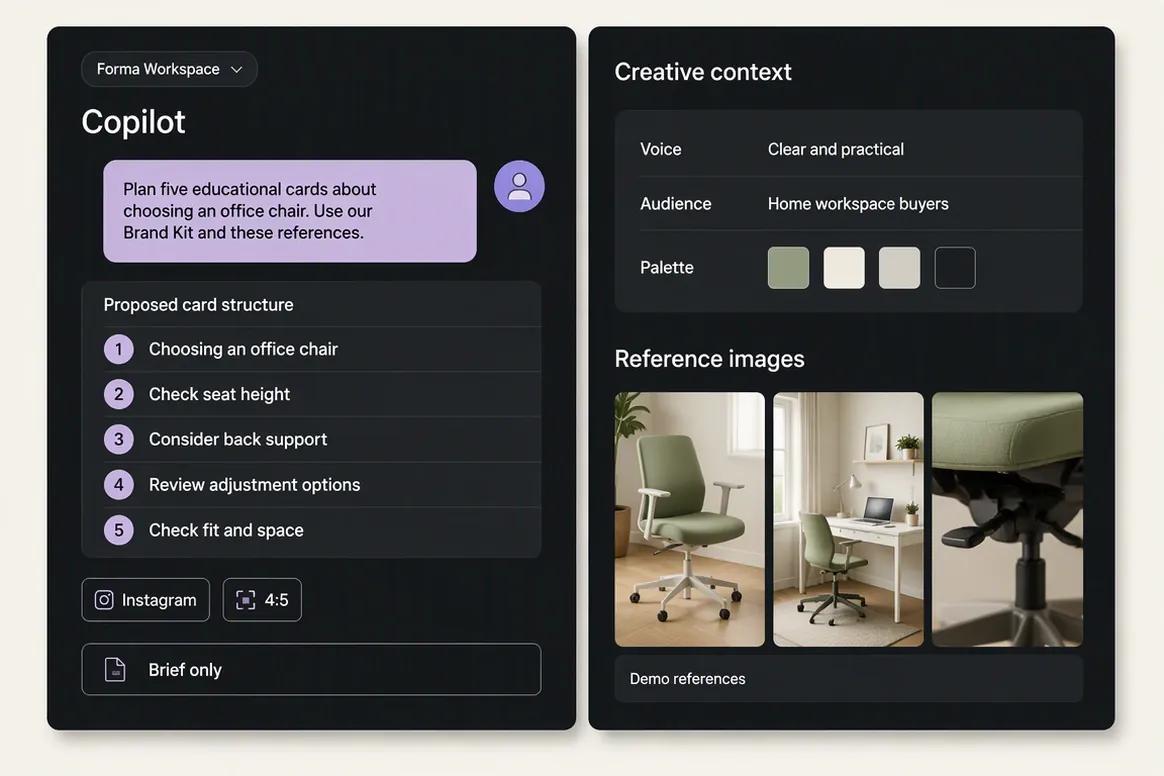
    Define the creative brief with Copilot

    Tell Copilot the visual's purpose, audience, format, message, and intended destination. Include Brand Kit context and reference images when they are relevant to the required visual direction.

    Ask Oolook Copilot
    “Help me prepare a five-card educational carousel about choosing the right office chair. Use our Brand Kit and these reference images.”
    Oolook Copilot preparing a brand-aware carousel brief
  2. 2

    Step 2

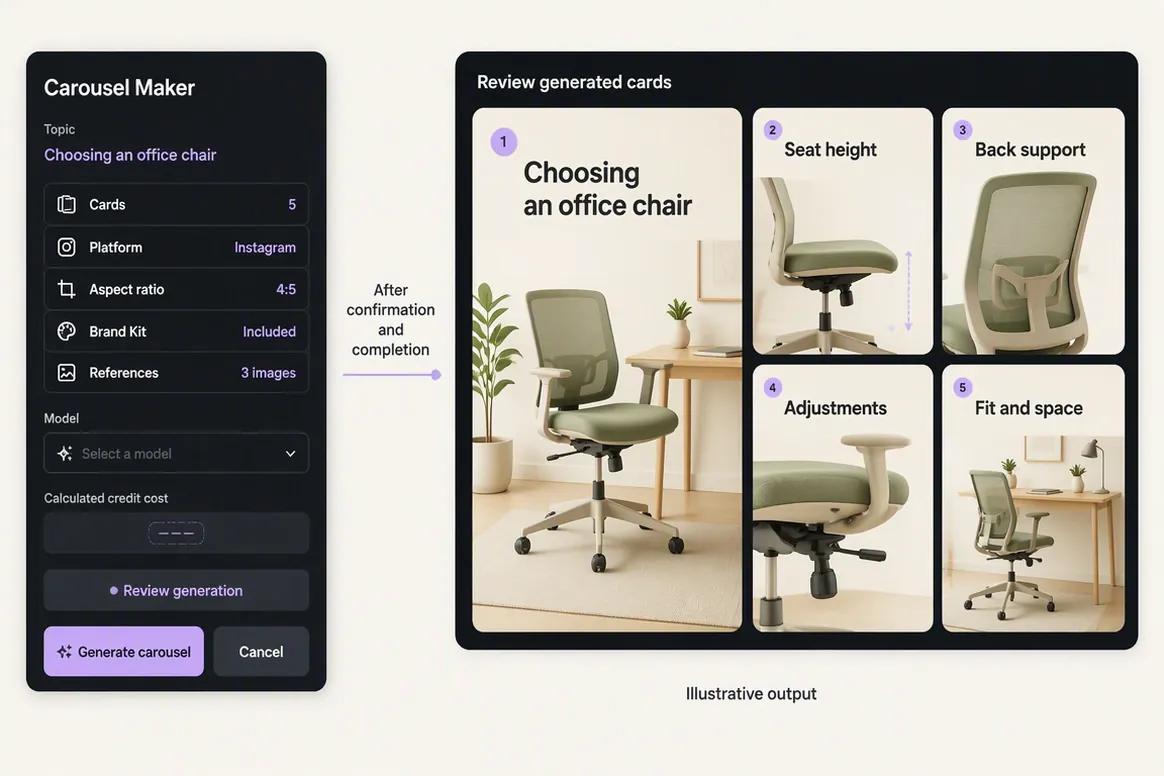
    Generate the visual assets

    Review the proposed structure and continue into the supported image or carousel generation workflow. Select the model, aspect ratio, resolution, reference images, and output count required for the creative.

    Ask Oolook Copilot
    “Prepare the carousel generation workflow using this approved card structure and visual direction.”
    Oolook generating coordinated visual assets for a social carousel
  3. 3

    Step 3

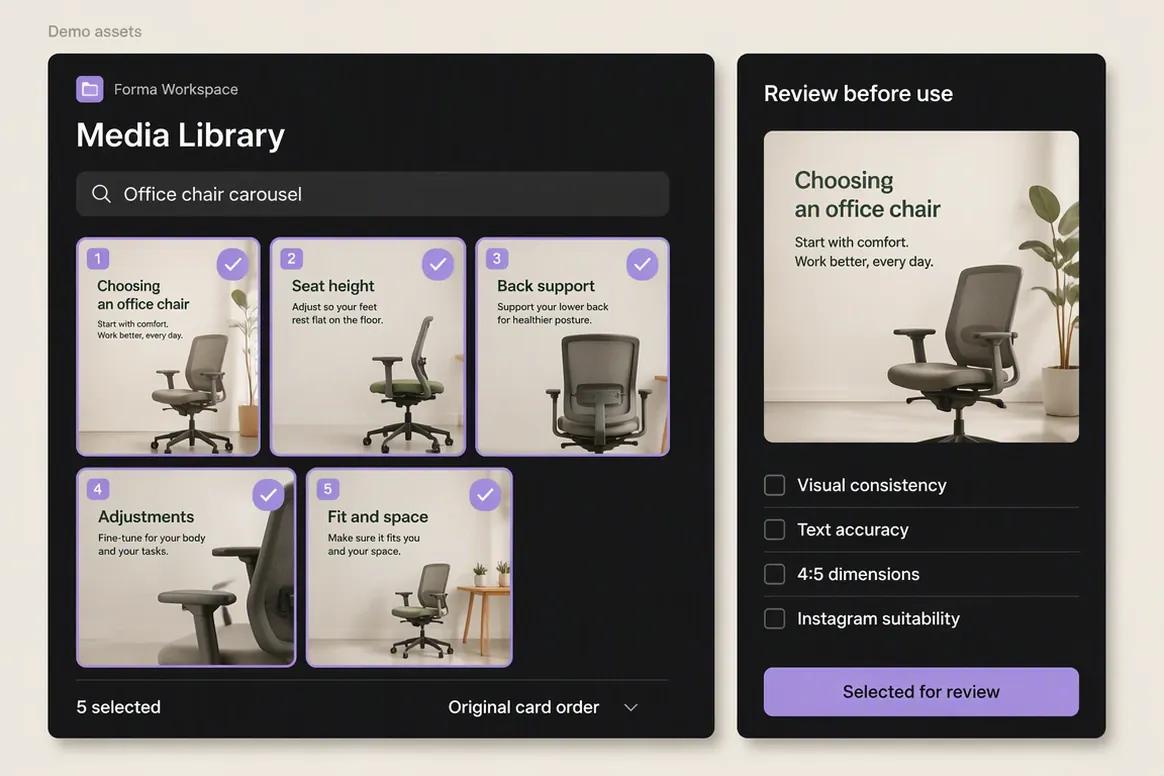
    Review and select the output

    Inspect visual consistency, text accuracy, composition, dimensions, and destination suitability. Save the approved generated outputs to the selected brand's Media Library for reuse.

    Ask Oolook Copilot
    “Find the generated carousel cards, check that the complete set is available, and help me prepare the selected assets for Instagram.”
    Oolook Media Library containing reviewed generated carousel assets
  4. 4

    Step 4

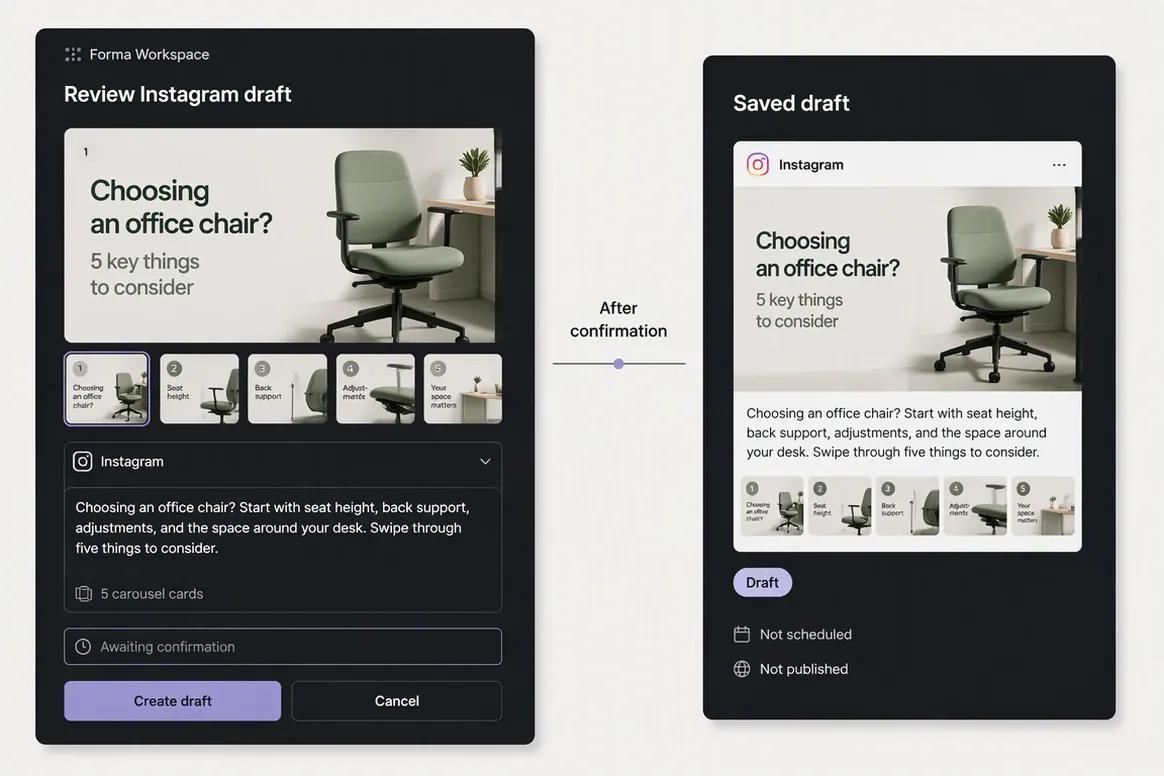
    Add copy and prepare publication

    Ask Copilot to prepare the destination-specific caption and publishing draft. Review the creative, caption, settings, and scheduled time together before confirming the action.

    Ask Oolook Copilot
    “Draft an Instagram caption for this carousel and prepare the complete post for review.”
    Oolook Instagram draft containing generated carousel cards and caption

Keep the Work Connected With Oolook Copilot

Move from brand context to reviewable content and supported actions without rebuilding the same marketing context across disconnected tools.

Start With Oolook

Why teams choose Oolook

Connect the Creative Asset to the Marketing Operation

Oolook focuses on the brand, media, publishing, reporting, and search-content work that surrounds day-to-day marketing execution.

Give Copilot the context of the marketing workspace

Oolook Copilot can work with available Brand Kit information, media, profiles, drafts, schedules, reports, search projects, and application history. It can connect brand context to supported marketing actions.

Review supported actions before execution

Oolook separates recommendations from workspace mutations. Supported changes are prepared for confirmation so your team can inspect what will happen before execution.

Connect media processing to the selected brand

Find an existing asset, then resize, reframe, upscale, remove its background, extract its palette, or adjust its colors without leaving the brand-specific Media Library.

Move from social execution into evaluated SEO content

Continue from brand and social work into researched article generation, evaluation, editing, reevaluation, and optimization without rebuilding context in another SEO product.

Where Canva is stronger

Canva Covers Far More of the Visual-Design Workflow

Canva has defensible advantages when the buyer needs templates, stock content, collaborative design, workplace products, websites, or print.

A large ecosystem of free and premium templates, stock photos, video, audio, graphics, fonts, icons, and creator content.
An accessible drag-and-drop editor designed for people without professional design training.
Canva AI and Magic Studio for writing, design generation, images, editing, resizing, translation, animation, charts, and other visual tasks.
Strong Brand Kits, Brand Templates, Brand Folders, and higher-tier Brand Controls.
Real-time visual collaboration, comments, review links, shared projects, version history, and design approvals.
A broad Visual Suite covering presentations, documents, whiteboards, sheets, websites, email designs, and interactive content.
Website creation and publishing with eligible custom-domain and basic SEO controls.
Canva Print for eligible physical products and fulfillment regions.
A broad Apps Marketplace and developer platform for connected visual workflows.
A permanent Free plan with templates, assets, storage, design tools, and limited AI access.

Workflow comparison

Two Different Ways to Move From Brand Setup to Output

Oolook starts with a selected brand workspace and connects content to marketing execution. Canva starts with visual creation and extends into collaboration, workplace content, publishing, websites, and print.

With Oolook

  1. 1Create a dedicated workspace for the brand.
  2. 2Configure structured Brand Kit information.
  3. 3Connect supported profiles and organize reusable media.
  4. 4Ask Copilot to inspect available workspace information or prepare content.
  5. 5Generate captions, images, carousels, or visual direction.
  6. 6Process existing media when a new generation is unnecessary.
  7. 7Review captions, media, and supported settings for each destination.
  8. 8Confirm supported actions and monitor publication status.
  9. 9Review available reports or continue into an SEO article workflow.

With Canva

  1. 1Create or join a Canva team.
  2. 2Configure Brand Kits, Brand Folders, and Brand Templates.
  3. 3Choose a template or start with Canva AI.
  4. 4Generate or edit text, images, video, audio, charts, or designs.
  5. 5Collaborate through comments, mentions, review links, and approvals.
  6. 6Resize and adapt the design for additional formats.
  7. 7Export, share, publish, print, or schedule through Content Planner.
  8. 8Review available design or post insights.
  9. 9Continue into presentations, websites, Docs, Sheets, or other Visual Suite products.

Current pricing

Compare Plans Against Your Real Monthly Workload

Compare the brands, social profiles, posts, storage, AI credits, reporting, and support your team actually needs.

Current Oolook plans

Loaded from Oolook's pricing API when this page opens.

Open the standard pricing page

Loading current Oolook plans…

Canva plans

Public pricing reviewed on October 1, 2026.

Check current Canva pricing

Canva Free

$0

Includes one user, one Brand Kit, 5 GB storage, free templates and assets, and limited AI access. Background Remover, Magic Resize, full Content Planner, and higher-tier brand controls are not included.

Canva Pro

About US$120/year for one person

Includes five Brand Kits, 100 GB storage, premium templates and assets, Background Remover, Magic Resize, Content Planner, and higher AI allowances. Confirm the current regional monthly and annual price before purchasing.

Canva Business

About US$200/year per person

Includes multi-user access, up to 100 Brand Kits under the reviewed terms, 500 GB storage, design approvals, stronger brand controls, team administration, and higher AI allowances. Regional prices can differ.

Canva Enterprise

Custom pricing

Sales-led plan for large organizations requiring advanced governance, multi-team management, higher Brand Kit limits, 1 TB storage under reviewed terms, SSO, SCIM, audit capabilities, support, and custom controls.

Do not compare price without comparing usage

The products solve different parts of the workflow. Oolook plans scale through brand workspaces, profiles, posts, storage, AI credits, reports, and support. Canva plans scale through users, Brand Kits, storage, premium content, AI allowances, collaboration, approvals, and governance. Compare your team size, brands, visual-design volume, social-publishing requirements, media-processing needs, stock-content usage, and SEO workflow requirements.

Canva prices and limits can change after the research date. Oolook values are loaded from its pricing API. Currency conversions outside INR are approximate. Confirm taxes, promotions, add-ons, checkout currency, and final billing terms before purchasing.

Make the decision

Do Not Confuse Design Breadth With Marketing Execution

Canva earns its place when visual creation, templates, collaboration, websites, and workplace content matter. Oolook becomes more relevant when the central problem is connecting brand context, reusable media, controlled social publishing, reporting, and SEO content.

Oolook is likely the better fit if:

  • You want marketing operations separated by brand workspace.
  • You need Copilot to inspect available workspace information.
  • You want supported workspace actions presented for confirmation.
  • You need destination-specific social content and publishing controls.
  • Platform validation, queue states, retries, and status monitoring matter.
  • You regularly process and reuse existing brand media.
  • You want social publishing and evaluated SEO article workflows together.

Canva is likely the better fit if:

  • Your main requirement is visual design rather than social operations.
  • Templates and premium stock content are central to your workflow.
  • Non-designers need a familiar collaborative visual editor.
  • You create presentations, documents, whiteboards, websites, or print.
  • You need broad visual collaboration and design approvals.
  • You want multiple Brand Kits and reusable Brand Templates.
  • Canva Content Planner covers your limited scheduling requirements.
  • You need Canva's Apps Marketplace or developer ecosystem.

Questions before you choose

Oolook vs Canva FAQs

Straight answers to the practical questions buyers ask before choosing between Oolook and Canva.

What is the main difference between Oolook and Canva?+

Canva is a broad visual-design and collaboration suite for graphics, video, presentations, documents, websites, whiteboards, print, and other creative work. Oolook is a focused brand-aware marketing workspace connecting creative generation, media processing, destination-specific social publishing, reporting, Copilot actions, and SEO article workflows.

Is Oolook a Canva alternative?+

Yes, for buyers comparing brand-aware social content creation, AI images, carousels, media tools, Brand Kits, asset reuse, and scheduling. It is not a complete replacement for Canva's template ecosystem, collaborative editor, presentations, websites, workplace products, or print fulfillment.

Which product is better for templates and stock content?+

Canva is the stronger fit when templates, stock photos, video, audio, graphics, fonts, icons, and fast drag-and-drop editing are central requirements.

Which product is better for social publishing?+

Oolook is likely the stronger fit when you need destination-specific captions and media, platform validation, visible queue states, retries, publishing-status monitoring, connected reports, and brand-workspace context. Canva Content Planner is better suited to lighter design-led scheduling.

Which product is better for Brand Kits?+

Both products support reusable brand information. Canva is strong for visual identity, templates, governance, and applying brand styles across designs. Oolook connects Brand Kit information to Copilot, social content, media, publishing, and SEO workflows inside each brand workspace.

Can Canva generate AI images and videos?+

Canva provides AI-assisted image and design generation through Canva AI, Magic Studio, Dream Lab, and related tools. Limited AI video-generation features are also available. Allowances and model access depend on the selected plan and tool tier.

Does Canva have a permanent free plan?+

Yes. Canva Free includes core design tools, one Brand Kit, 5 GB storage, free templates and assets, and limited AI usage. Premium content and advanced tools require a paid plan.

Does Oolook have a free plan?+

Yes. Oolook's standard pricing includes an available Free plan. Current brand, profile, post, storage, AI-credit, channel, reporting, and support limits are loaded from Oolook's pricing API in the pricing section.

Can Canva schedule social media posts?+

Yes. Canva Content Planner can schedule designs to a defined list of supported social destinations on eligible plans. Connection, account-type, format, and destination restrictions apply.

Does Canva provide a social inbox or social listening?+

A comprehensive social inbox for direct messages, comments, mentions, assignments, and saved replies was not verified. Native social listening, competitor monitoring, sentiment analysis, and social share-of-voice tracking were also not verified.

Which product has stronger SEO content workflows?+

Oolook is the stronger fit within the established comparison scope because it supports researched article generation, evaluation, editing, reevaluation, and optimization. Canva provides Magic Write, website creation, and basic website SEO controls, but a comparable SEO article workflow was not verified.

Which product is better for agencies?+

Canva is likely stronger when an agency needs collaborative design, templates, client Brand Kits, presentations, websites, and visual approvals. Oolook is likely stronger when each client needs connected brand context, media processing, destination-specific social publishing, reports, Copilot actions, and SEO content workflows.

Can I migrate automatically from Canva to Oolook?+

No one-click migration was verified. Migration would likely involve exporting designs and assets, recreating Brand Kits and workspaces, rebuilding scheduled posts, reconnecting social accounts, and inviting users again.

Can either product guarantee engagement, rankings, or sales?+

No. Results depend on your offer, audience, creative quality, execution, market, platform algorithms, search competition, and other external factors. Neither product should be treated as a guarantee of engagement, rankings, leads, conversions, or revenue.

Research and sources

Check the Details That Matter to Your Purchase

This comparison uses established Oolook product information and official Canva product, pricing, AI, Brand Kit, Content Planner, Help Center, and developer sources.

Canva is a trademark of its respective owner. Oolook is not affiliated with or endorsed by Canva. Product names, prices, regional billing, AI allowances, content licenses, Brand Kit limits, storage, supported destinations, and policies can change. Confirm the current Canva pricing and Help Center information before purchasing. If you identify an inaccurate statement, contact Yogesh@oolook.in.

Build around marketing execution

Connect Brand Context, Creative Assets, Publishing, and Search Content

Use Oolook to connect your Brand Kit, Copilot, creative tools, reusable Media Library, social publishing, reporting, and SEO content workflows.