| Best suited to | Teams that want brand-aware AI creation, media processing, social publishing, reporting, and SEO workflows. | Mid-market and enterprise organizations that need governed asset storage, AI discovery, video intelligence, portals, rights, global distribution, and Azure security. |
|---|
| Operating model | Uses separate brand workspaces containing Brand Kit context, media, profiles, posts, reports, and search projects. | Uses DAM libraries, categories, custom metadata, permissions, Collections, galleries, lightboxes, and Experience Portals. |
|---|
| Multi-brand organization | Each workspace separates brand context, assets, profiles, schedules, content, and reports. | Uses categories, permission groups, libraries, and Portals to separate brands, regions, departments, clients, and external audiences. |
|---|
| Brand context | Structured Brand Kit information guides supported Copilot, social, visual, media, and SEO workflows. | Supports governed brand assets, portals, templates, metadata, and standards, but a comparable structured voice and audience context object was not verified. |
|---|
| AI approach | Copilot can inspect available workspace information, generate content, and prepare supported actions for confirmation. | AI focuses on automatic tagging, recognition, metadata enrichment, natural-language discovery, face search, video transcription, and rights enforcement. |
|---|
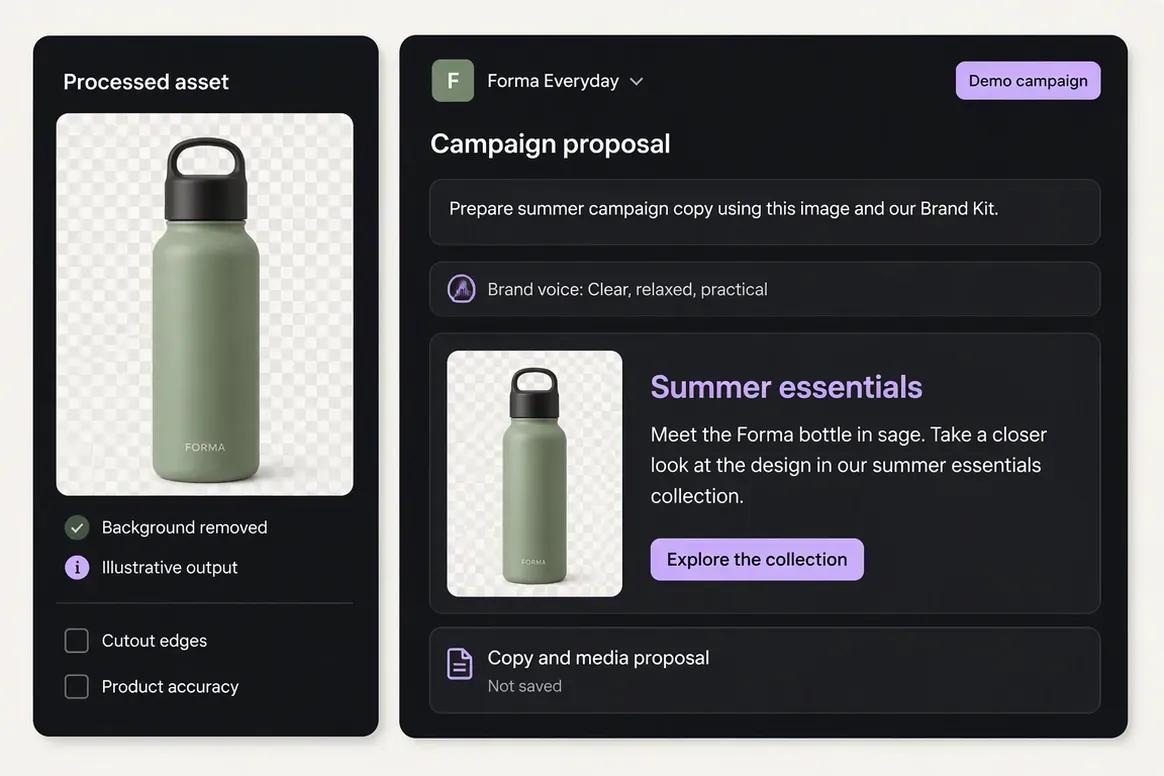
| Generative creation | Generates captions, variants, images, coordinated carousels, and visual direction. | Native prompt-based social captions, images, videos, carousels, and moodboards were not verified as core DAM features. |
|---|
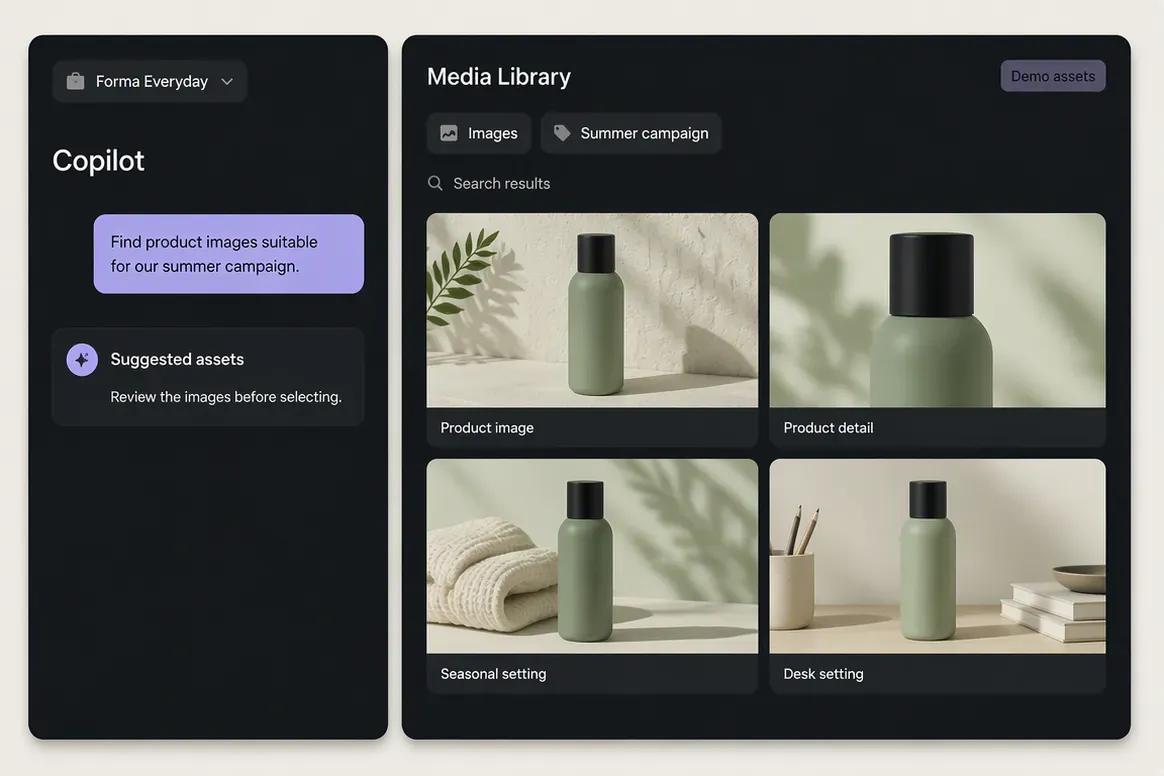
| Media Library | Provides brand-specific uploads, generated assets, search, processing, organization, and reuse. | Provides enterprise DAM storage with unlimited reviewed categories, custom metadata, related assets, versions, rights, permissions, and large-file support. |
|---|
| Search and AI tagging | Supports structured and semantic search within brand Media Libraries. | Provides advanced keyword, metadata, category, natural-language, object, face, color, OCR, similarity, and video-transcript discovery. |
|---|
| Video management | Supports established video processing, background removal, and upscaling workflows. | Provides enterprise video management with transcription, subtitles, scene detection, speaker and topic analysis, transcoding, proxies, clipping, thumbnails, and streaming. |
|---|
| Rights management | Workspace permissions and asset organization are available within the established scope. | Supports licensing, copyright, consent, territory, channel, expiration, embargo, watermark, rights-document, download, and audit controls. |
|---|
| Version control | Asset history is available within established Media Library workflows. | Provides version history, replacement, asset history, related assets, approvals, and governed lifecycle management. |
|---|
| Experience Portals | Enterprise external asset portals are not positioned as an established advantage. | Provides branded public or private Experience Portals for press, partners, dealers, franchises, employees, agencies, and other audiences. |
|---|
| CDN delivery | Oolook focuses on creation, reuse, processing, and supported marketing publishing. | Provides global CDN linking, embedded delivery, streaming, download presets, and Azure-backed global distribution. |
|---|
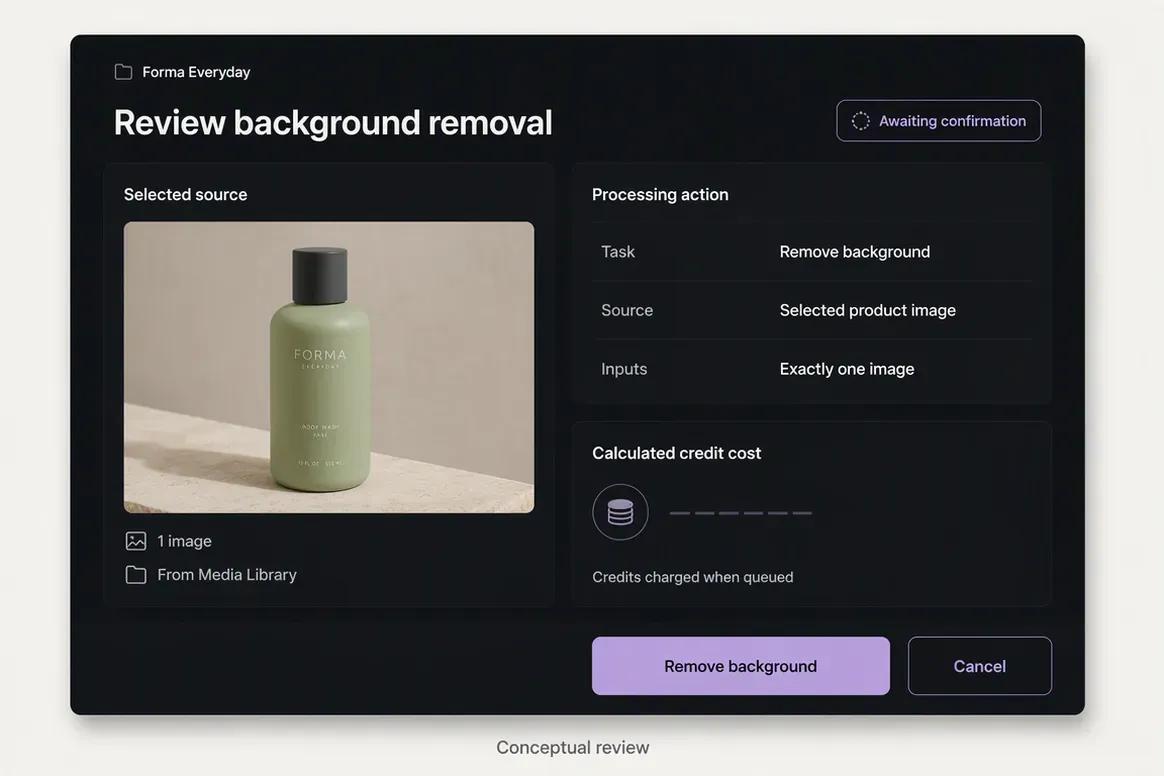
| Media processing | Includes background removal, resizing, reframing, upscaling, palette extraction, and color grading. | Provides delivery-oriented conversion, resizing, cropping, compression, transcoding, proxies, clipping, renditions, and watermarking. |
|---|
| Creative templates | Provides AI generation and focused creative applications inside each workspace. | Supports controlled on-brand templates through native capabilities and integrations such as Marq, Adobe, Canva, and Figma. |
|---|
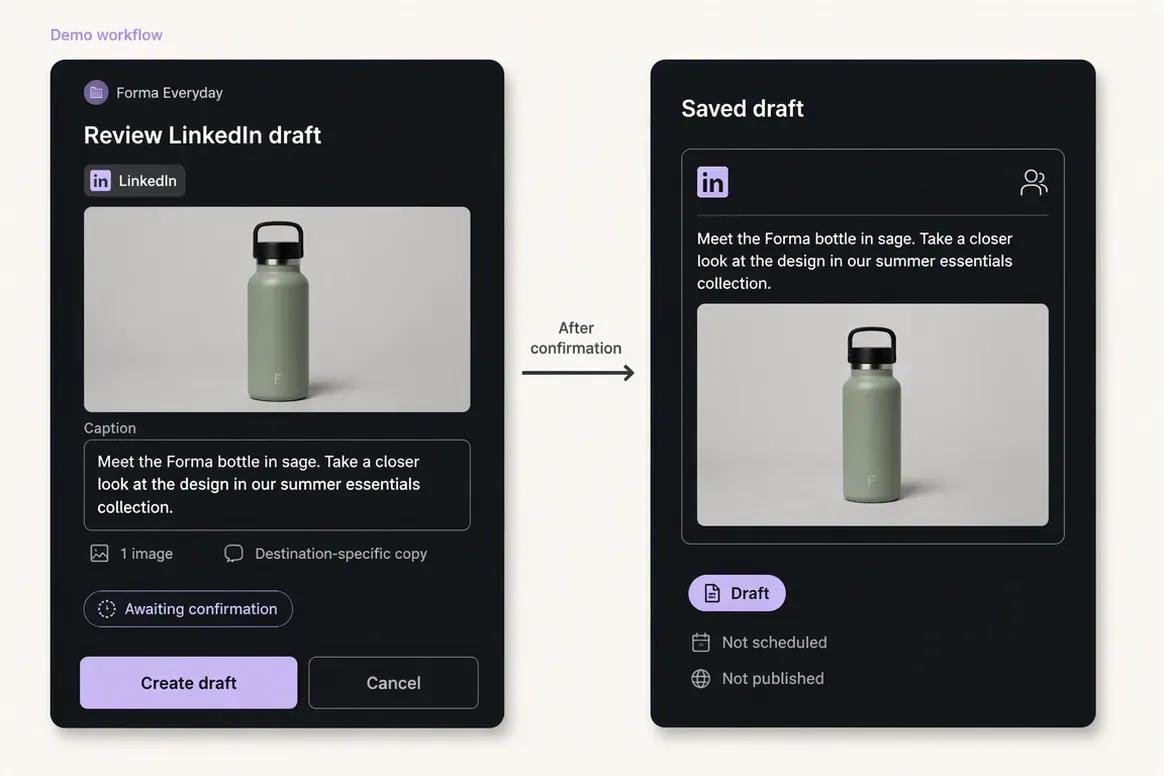
| Social publishing | Supports drafts, scheduling, platform-specific content, validation, queue states, retries, and publishing-status monitoring. | Native social-account connections and direct publishing were not verified. Distribution occurs through Portals, CDN, integrations, and external marketing tools. |
|---|
| Social reporting | Provides available profile and post metrics from supported connected networks. | Analytics focus on asset views, downloads, searches, shares, user activity, Portals, embeds, CDN, storage, and video usage. |
|---|
| SEO content workflow | Supports researched article generation, evaluation, editing, reevaluation, and optimization. | A native SEO article research, scoring, audit, generation, and optimization workflow was not verified. |
|---|
| Collaboration | Supports shared-content feedback and reviewable Copilot actions, with plan-dependent permissions. | Supports comments, annotations, proofing, approvals, requests, notifications, external reviewers, and project-management integrations. |
|---|
| Enterprise governance | Enterprise options depend on current Oolook commercial terms. | Provides granular permissions, SSO, MFA, auditability, data residency, encryption, Azure architecture, and documented compliance controls. |
|---|
| Integrations | Connects its own creative, media, publishing, reporting, and SEO workflows. | Integrates with Microsoft 365, Teams, SharePoint, OneDrive, Adobe, Canva, Figma, storage, CMS, PIM, CRM, project-management, and other enterprise systems. |
|---|
| API | Public API access is not positioned as an established advantage. | Provides Open API access with OAuth, webhooks, uploads, search, metadata, assets, users, Portals, reports, downloads, and enterprise usage options. |
|---|
| Free access | Offers an available Free plan with current limits loaded from the pricing API. | Offers a free sandbox for evaluation, but no permanent Free production plan or self-serve monthly package was identified. |
|---|
| Pricing basis | Plans scale through workspaces, profiles, posts, storage, AI credits, reports, and support. | Pricing is entirely custom and primarily driven by storage, configuration, integrations, video requirements, implementation, and enterprise needs rather than user seats. |
|---|