| Best suited to | Teams that need brand-aware content creation, media processing, social publishing, reporting, and SEO execution. | Marketing, SEO, GEO, agency, and ecommerce teams that need dedicated AI-answer visibility and citation intelligence. |
|---|
| Operating model | Uses brand workspaces containing Brand Kit context, media, social profiles, content, reports, and search projects. | Uses projects for brands or clients, with prompts, engines, competitors, sources, markets, languages, metrics, and recommendations. |
|---|
| Multi-brand management | Separates each brand's context, assets, profiles, posts, reports, and content workflows. | Supports multiple brand projects, sub-brands, countries, languages, client projects, pitch projects, and consolidated agency billing. |
|---|
| AI-search tracking | Any comparison involving current Oolook AI-search monitoring is conditional on verified production availability. | Purpose-built for daily tracking of how brands appear across selected AI answer engines. |
|---|
| AI platform coverage | Current engine coverage must be verified before making direct AI-search claims. | Tracks selected engines such as ChatGPT, Google AI Mode, AI Overviews, Gemini, Copilot, and other plan-dependent models. |
|---|
| Prompt tracking | Oolook's established strengths in this comparison are content and execution rather than dedicated prompt monitoring. | Tracks manual, suggested, imported, tagged, clustered, location-specific, and language-specific prompts on scheduled runs. |
|---|
| Visibility metrics | Current AI-search visibility metrics require production verification. | Measures visibility, average position, sentiment, share of voice, recommendation coverage, and historical changes. |
|---|
| Citation tracking | Current citation-monitoring availability must be verified before direct comparison. | Tracks cited domains, URLs, source frequency, classifications, competitor sources, fan-out queries, and citation gaps. |
|---|
| Competitor intelligence | Supports competitor research within established SEO content workflows. | Discovers competitors and compares visibility, prompts, sentiment, citations, platforms, topics, and share of voice. |
|---|
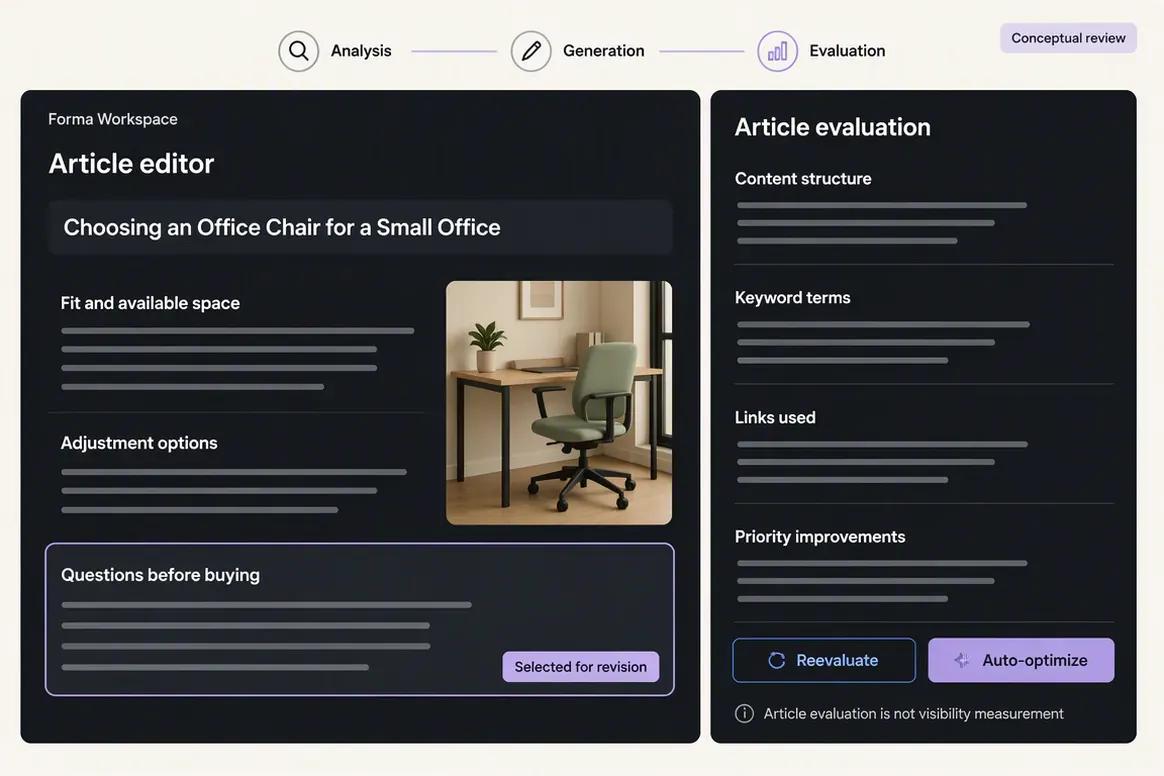
| Content opportunities | Provides researched content generation, evaluation, editing, reevaluation, and optimization. | Surfaces owned and earned media gaps, missing prompts, citation opportunities, source gaps, and prioritized recommendations. |
|---|
| Content execution | Generates and edits social and SEO content inside the selected brand workspace. | Primarily monitors and recommends. A complete native article-production and publishing pipeline was not verified. |
|---|
| Traditional SEO | Supports article research, generation, evaluation, editing, reevaluation, and optimization. | Focuses on AI search rather than traditional keyword volume, backlinks, SERP rank tracking, and full technical SEO audits. |
|---|
| Social publishing | Supports drafting, scheduling, publishing, destination controls, validation, retries, queues, and status monitoring. | Social profile connections, scheduling, publishing, and social analytics were not verified. |
|---|
| Creative generation | Generates captions, images, coordinated carousels, and moodboards. | Native social copy, image, video, carousel, and moodboard generation were not verified. |
|---|
| Media processing | Includes image and video background removal, resizing, reframing, palette extraction, color grading, and upscaling. | A media library and creative-processing suite are outside Peec AI's core product scope. |
|---|
| Reporting | Provides connected social reports and workspace information within the broader marketing workflow. | Provides AI-search dashboards, shareable views, CSV exports, Looker Studio, MCP reports, and Enterprise API access. |
|---|
| Methodology | AI-search methodology must be verified if current tracking is used in a direct claim. | Uses UI scraping designed to simulate logged-out user interactions and capture user-facing answers and sources. |
|---|
| Agency workflows | Provides separate brand workspaces and plan-dependent collaboration. | Agency plans support client projects, pitch projects, client seats, team users, prompt credits, consolidated billing, and reporting. |
|---|
| Users | Current seat allowances depend on the selected plan. | Self-serve brand plans are described as including unlimited team users. |
|---|
| API and MCP | Public API and MCP are not positioned as established Oolook advantages. | Provides MCP access broadly and Customer API access on Enterprise or eligible agency tiers. |
|---|
| Security | Security capabilities depend on current Oolook commercial and production terms. | Documents GDPR alignment, encryption, restricted access, SAML SSO on Enterprise, and a sales-assisted DPA process. SOC 2 was described as in progress. |
|---|
| Free access | Offers an available Free plan, with current limits loaded from Oolook's pricing API. | No permanent Free plan was identified. Published self-serve plans begin at a mid-market monthly price. |
|---|
| Pricing basis | Plans scale through brands, profiles, posts, storage, AI credits, reporting, and support. | Brand plans scale through prompts, engines, projects, countries, languages, reports, and integrations. Agency plans use prompt-run credits. |
|---|